
When you search for something on Google — like “best digital marketing agency in UAE” — you instantly get millions of results. But how does Google decide which website comes first? Why do some pages show up on page 1 and others on page 10?
To understand SEO properly, you must first understand how search engines work.
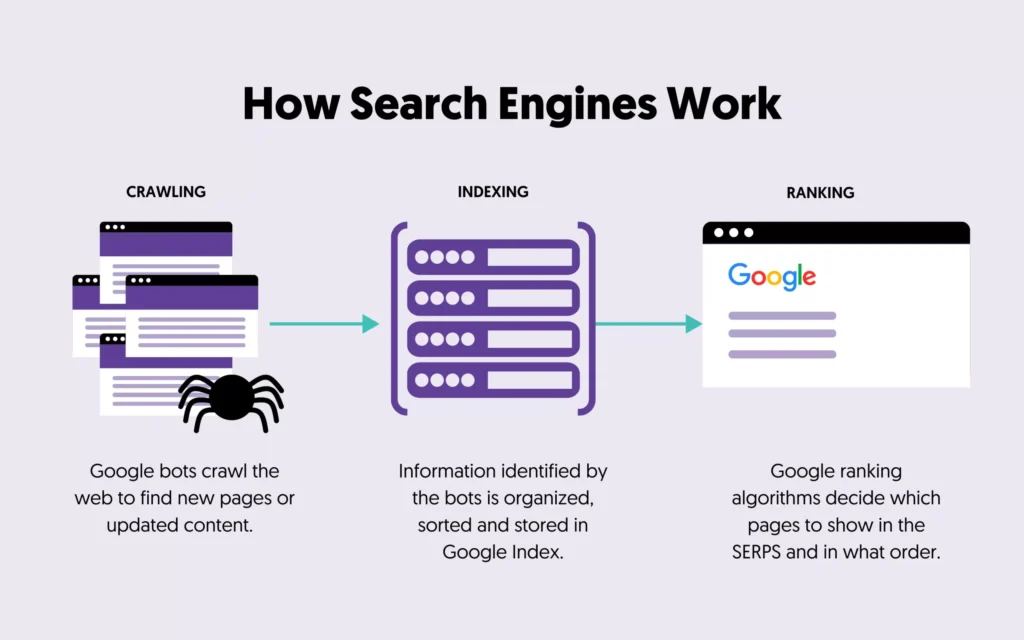
Google follows three essential steps:
👉 Crawling
👉 Indexing
👉 Ranking
Let’s break each one down simply.
🔍 1. Crawling — Google Finds Your Website
Crawling is the process where Google’s bots (called Googlebots) scan the internet to discover new and updated pages.
✔ How Does Crawling Work?
- Googlebot follows links from one page to another
- It reads your page content
- It scans your headings, images, links, and text
- It checks your website structure
If your website is easy to crawl, Google can discover your content faster.
✔ Factors That Affect Crawling:
- Website speed
- Clean URLs
- Mobile-friendly design
- Internal linking
- Sitemap
- Robots.txt file
If Google cannot crawl your site properly, your pages will never appear on search results, no matter how good your content is.
📘 2. Indexing — Google Stores Your Page in Its Database
Once Google crawls your page, it needs to store the information.
This process is called indexing.
✔ During Indexing, Google:
- Understands the topic of your page
- Analyzes your keywords
- Reads your headings (H1, H2, H3)
- Checks your images and alt text
- Evaluates content quality
- Understands user intent
✔ Why Your Page May Not Get Indexed:
- Thin or low-quality content
- Duplicate content
- Broken links
- Blocked in robots.txt
- Slow website
- No unique value
You can check indexing status using Google Search Console.
🏆 3. Ranking — Google Decides Which Page Comes First
Ranking is the process where Google decides the position of your page on the search results.
Google uses 200+ ranking factors, but the top ones include:
✔ Relevance
Does your content match what the user searched?
✔ Quality of Content
- Detailed
- Helpful
- Well-structured
- Unique
✔ User Engagement
Do people spend time reading or bounce immediately?
✔ Mobile-Friendliness
Most UAE users browse using mobile devices.
✔ Website Speed
Faster websites = better ranking.
✔ Backlinks
If trusted websites link to you, Google trusts you more.
✔ Search Intent
Google tries to show pages that match exactly what users want.
✔ Freshness
Updated content ranks higher for trending topics.
✔ Local Signals (Important in UAE)
Google considers:
- Location
- Google My Business
- Local citations
This helps UAE businesses rank for local searches like “restaurant in Dubai Marina”.
🇦🇪 How This Works for UAE Businesses
Google’s algorithm also considers local relevance.
Examples:
- A user in Dubai searching “best dentist near me” will see Dubai-based websites.
- A person in Abu Dhabi searching “SEO expert” will see local results first.
- Local keywords like “in UAE”, “Dubai”, “Sharjah”, “Abu Dhabi” perform better.
This makes local SEO extremely important for UAE businesses.
🎯 Simple Summary
Here’s how search engines work in 3 steps:
1. Crawling:
Googlebot discovers your page.
2. Indexing:
Google stores your page in its database.
3. Ranking:
Google decides where to place your page on search results.
If your website is easy to crawl, properly indexed, and high-quality — you will rank higher.
🏁 Conclusion
Understanding how search engines work is the foundation of SEO. When you optimize your website for crawling, indexing, and ranking, you increase your chances of appearing on page 1. Whether you’re a freelancer in the UAE or a business owner, mastering these basics will help you grow faster and attract consistent traffic.